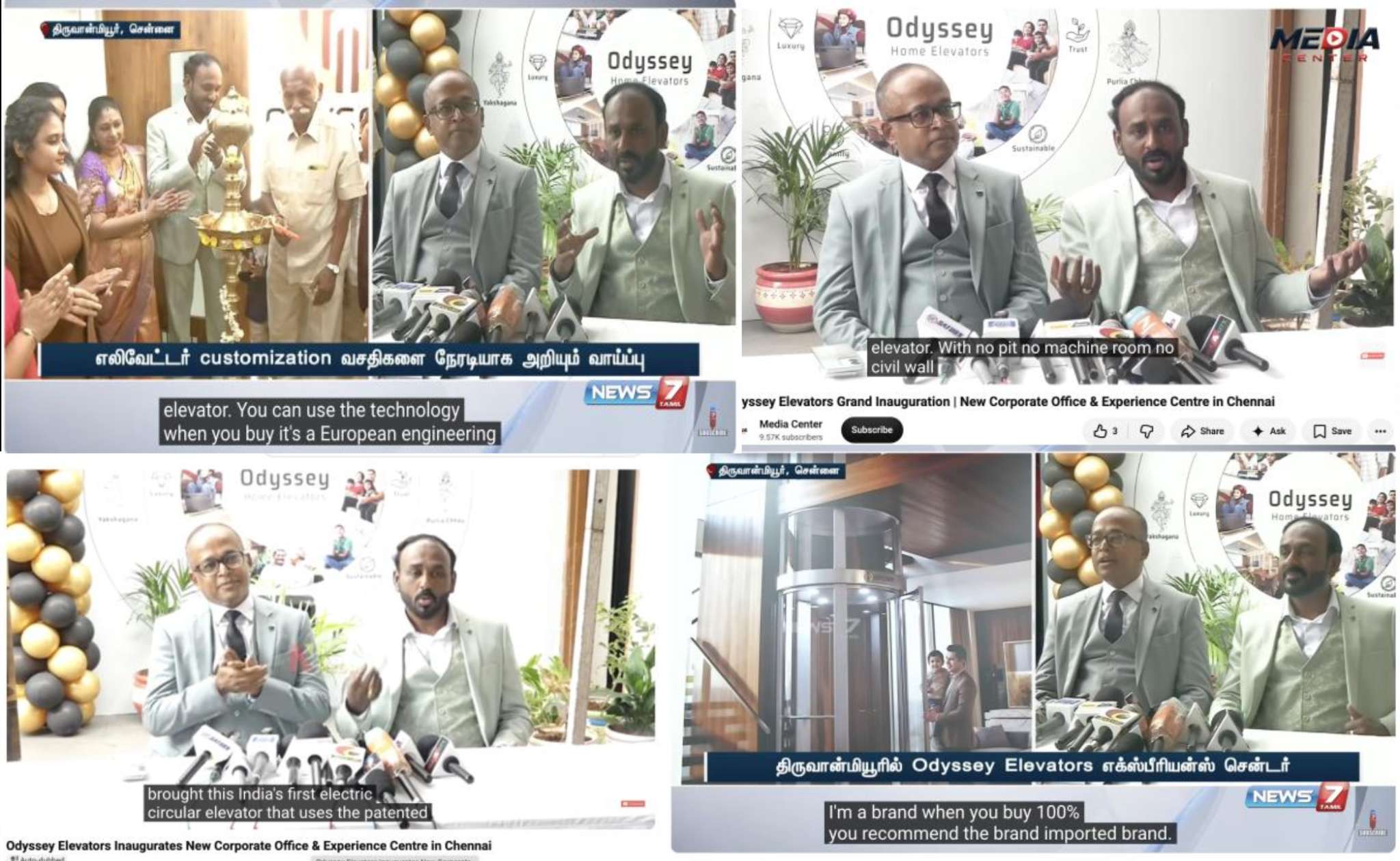
Odyssey Elevators is expanding its physical presence with the inauguration of its new experience centres in Chennai and Lucknow, positioning the brand for greater visibility in India's premium home-elevator market. While the new showrooms offer customers an opportunity to see and experience the products, questions remain over whether equally clear information is being provided on the technical and documentary aspects of the elevators being marketed.
Odyssey recently inaugurated its Corporate Headquarters and Elevator Experience Centre in Chennai, while its Lucknow Experience Centre was launched earlier in September. The company has promoted these centres as part of its expansion and customer-experience strategy.
But for customers considering a high-value home elevator, a showroom demonstration is only one part of the purchasing decision. The bigger questions concern what is actually being supplied, where it is manufactured, what certification applies to the specific product, and what lifting mechanism is installed.
“Electric Lift” — But What Exactly Is the Lifting Mechanism?
One of the questions being raised concerns Odyssey's use of the term “electric” in describing its home elevators.
An elevator being electrically powered does not, by itself, establish whether the lifting arrangement is traction-based or drum-winding. An electric motor can power different types of lifting systems. Therefore, customers may reasonably ask Odyssey to clearly identify the exact mechanism used in the elevator being offered to them.
Publicly available reporting has raised questions about whether certain Odyssey models described or understood as traction elevators may instead employ a drum-winding arrangement. Those reports also acknowledge that visual footage alone is not conclusive and that the company could resolve the issue by publishing definitive technical documentation.
The issue, therefore, is not whether drum-winding technology can be used in an elevator. It can. The issue is whether customers are being clearly told what mechanism they are purchasing.
If the elevator uses drum-winding technology, customers deserve to know that before making a purchase rather than having to discover the technical distinction independently.
Where Is the Elevator Actually Manufactured?
A second question concerns manufacturing origin.
Odyssey's public marketing has referred to European engineering and imported European components, while other publicly available information has associated its products with Turkish home-lift solutions. These descriptions make it important for prospective buyers to understand the distinction between European engineering, European components, European manufacturing, Turkish manufacturing, importing and local assembly.
Customers should not have to interpret marketing terminology to determine the origin of a product costing several lakh rupees.
The straightforward questions are:
Who is the legal manufacturer? Where is the complete elevator manufactured? What is the exact factory address? Which components are imported? Where does assembly take place? And which entity is responsible for the product supplied to the Indian customer?
Odyssey's current website lists a Chennai corporate address and UDYAM registration details, but a corporate or experience-centre address is not necessarily the same thing as a manufacturing-facility address.
Certification: Customers Deserve Product-Specific Answers
Certification is another area where greater transparency could help customers.
A certificate associated with a company, quality-management system or business registration should not automatically be understood as certification of a particular elevator model. Customers purchasing an elevator should be able to identify the exact model covered, applicable standards, Declaration of Conformity, test documentation and the organisation responsible for the conformity assessment, where applicable.
Previous reporting has specifically highlighted the distinction between management-system certification and product-specific elevator certification and has suggested that customers request documentation relating directly to the equipment being purchased.
That distinction matters because a customer is not purchasing a certificate or a showroom experience. The customer is purchasing an actual elevator.
Expansion Should Come With Greater Transparency
There is nothing unusual about an elevator company opening new experience centres as it expands. In fact, greater physical presence can make it easier for customers to interact with the company.
However, expansion also brings greater responsibility for transparency.
As Odyssey increases its presence in cities such as Chennai and Lucknow, customers should be able to receive straightforward answers to basic technical questions:
- What exact lifting mechanism does the elevator use?
- Is the supplied configuration traction-based or drum-winding?
- Where is the complete elevator manufactured?
- Who is the actual manufacturer?
- Which components are imported and from which country?
- What product-specific certification applies?
- Does the certification correspond to the exact model and configuration being sold?
- Where can customers examine the relevant technical and conformity documents?
These are not unreasonable questions for a homeowner making a substantial investment in a home elevator.
A showroom can demonstrate how a lift looks and operates. Documentation should demonstrate what the customer is actually buying.
Odyssey now has an opportunity to address these questions publicly and conclusively by publishing the relevant certification documents, identifying the actual manufacturing facility and clearly specifying the lifting mechanism used in each model.
Until then, the central issue for prospective buyers is simple: look beyond the showroom, the branding and the terminology, and ask for the technical documentation behind the product.